Showing posts with label speech language pathology games. Show all posts

Monday, April 29, 2013

Headbandz


Take a peek into my speech room this week! We are using Headbandz!


This game is great for working on:

Asking Questions – You must ask a question to gain clues to determine what you are!

Answering Questions – Players must answer question correctly to help their friendsz

Describing- You may have to describe what is on your friendz head!

Making Inferences – You must gather clues and use information you already know to figure out what is on your card!

Turn Taking- Take turns asking questions!

 My kids have a blast when I pull out this game!

How it works: First put on a headband! Then have another player put your card on your headband. Then you must ask questions to figure out what you are!
 

The game also comes with question cheat sheets to help students think up questions to ask!

Have you used this game before? What are some of your favorite speech toys?


Tuesday, February 12, 2013

Tangled Tuseday


I was very excited when Amy from Major Speech Pathology Fun bya Minor Girl contacted me about doing Tangled Tuesday! I think this is a fabulous idea where we as SLPs can showcase ideas and products created by other SLPs. I am always amazed and inspired by the creativity and dedication of my peers!

I have been using Popcorn Category and Definition Activity in my speech room for a few weeks. I loved that this is the activity Amy sent me because one of my rooms is decorated in the popcorn theme! So it fit perfectly!

I have used this activity with my kindergarteners and 1st graders. They really seem to enjoy it and keep asking when I am going to bring them real popcorn! Ha! Guess I should get on that!

I have used this several ways. When I first introduced it to my students, we just used the popcorn category buckets and cards. Some of my students really need a concept broken down before they can follow multiple steps in a game. 


Once they caught on to identifying the category, then I incorporated giving definitions. Then next time we played I gave them the popcorn stash placemat to use. They acted like it was a totally new game then! I just LOVE when there is an activity they you can use multiple times!


I have a fluency student in one of my language groups (oh scheduling… you know how that goes) and I had him pull a card and use his fluency tools and make up a sentence. It worked great in the game! More bonus points for being able to use this activity in multiple ways!

I was so pleased with this activity and my kids were happy that I had a new way to present categories and vocabulary to them. (They had begun whining when I pulled out my trusty flashcards!) My one tip is to print a few pages of the popcorn pieces! My kids went through those fast!

This product includes 59 picture cards, 6 lose your turn cards, 6 go again cards, 2 student popcorn boxes, placemat, 4 category boxes, and 30 popcorn pieces.

This cute printable is only $5.00 on TpT. Stop by Amy’s store and get it here! Also, be sure to “Like” her on Facebook and stop by her blog to see what she thought about my ‘Answer Me, Maybe’ WH question activity!


Thursday, February 7, 2013

Slap That! Articualtion Game

Around this time of year my kids get really antsy. They are already asking how much longer until Spring Break (I don’t blame them… I already started a countdown for the end of the year! Ha!). So I needed a new game that let them move around. And so Slap That was born!


How to play? It’s simple. All of the picture cards are spread across the table face up. Then the SLP reads a word card. The first student to spot the corresponding picture and slap it gets to keep the card. Once the student slaps the card they must say the word/ phrase/ sentence x number of times. The player with the most cards in the end wins.


If you are playing with readers, then print 2 sets of the word cards and have them find the word instead of the picture.

Beware of crushed fingers! While most of my students could play without getting too overzealous, a few needed reminders to slap the card and not their friend’s hand.

This game includes the k, f, and l phonemes. There are 24 words/ pictures for each sound position and 3 wild cards. Just print, cut, laminate and go!

Grab this game for $3.50 in our TpT store!

To win a free copy, just leave a comment telling us your favorite product from The Speech Ladies TpT store and your e-mail!


Thursday, January 24, 2013

Word Retrieval App


Time for another app review! Today we are looking at the WordRetrieval App from the Virtual Speech Center! (To see a review for Articulation Games from the Virtual Speech Center go here.)


Why am I excited about this app? Because I can use it to target goals from my TBI students! Yay! Finding new materials for these students can be difficult since they are older and seem to get board fast!

What does this app do? Well, helps people with work retrieval problems. (And some days I feel like I am one of those people! Ha!) It is a flashcard or jeopardy style game that allows you to target skills such as naming a picture, sentence completion, opposites, associations, and convergent/ divergent naming.


Who could I use this with? Well, I used it with my TBI students but you could also use it with students who have aphasia, Central Auditory Processing Disorder, and other language disorders.

It is simple to use and collects data for you, as all good apps do! It is $9.99 in the app store!


To see how you use it watch the video below. 


Saturday, November 10, 2012

Thanksgiving Freebie


To show how grateful we are for each of you we made a Thanksgiving freebie!


Just print on cardstock, and cut out each turkey and feather (when you are done cutting you should have 7 feathers for each turkey) and laminate for durability!


Then have your students match the feathers to the correct turkey according to the category. This is also a great opportunity to learn new vocabulary, ask and answer WH questions!


To grab this freebie go here! Hope you enjoy! Let us know what you think!

Thursday, November 1, 2012

2 Myths and a Truth

I created 2 Myths and a Truth from the old game 2 truths and a lie. Have you ever played? I just switched it up! GIVEAWAY at the end!


 It is really simple! In my version a player picks a card and reads 3 facts. Each card has 2 myths and 1 truth about stuttering. The player who picks the card must decide which fact is true! If they choose correctly they get to keep the card. If not, they must put the card in the bottom of the stack. But watch out! An owl might eat your snail and you will have to put all of your cards back in the pile. The player with the most cards at the end of the game wins.
 
 
I created this game specifically for one of my 5th graders who stutters. Last year was his first experience with speech therapy. We worked very hard on all of the ‘tools’ he could use to produce smooth speech and he really started catching on! However, when the new school year started I realized I had neglected to teach any facts about stuttering.

For whatever reason, it had not occurred to me to remind of known facts such as ‘more males than females stutter’ and ‘there is no known cause for stuttering’. (To learn more about stuttering be sure to visit stutteringhelp.org) I realized that was a major FAIL on my part when I overheard a conversation between him and another speech student. It went something like this:

Student A: "Why do you come to speech?"

Student B: "Because I stutter."

Student A: "Oh. How come you stutter?"

Student B: "Because my grandmother locked me in a room and made me watch a scary movie when I was little."

YIKES! RED FLAG! I might have taught fluency techniques, but I had failed to teach about stuttering in general.
And please let me add that I spoke with Student B one on one later that day and he confessed that his grandmother did not lock him in a room. He just didn’t know what to say when people ask why he stutters. Since then I have done a lot of educating on facts and spent more time on how he feels about his stuttering.
To get this game go to my TPT store.

One lucky winner will get a copy of 2 Myths and a Truth! To enter leave a comment with you e-mail and what has helped you teach your students about stuttering!


Tuesday, February 14, 2012

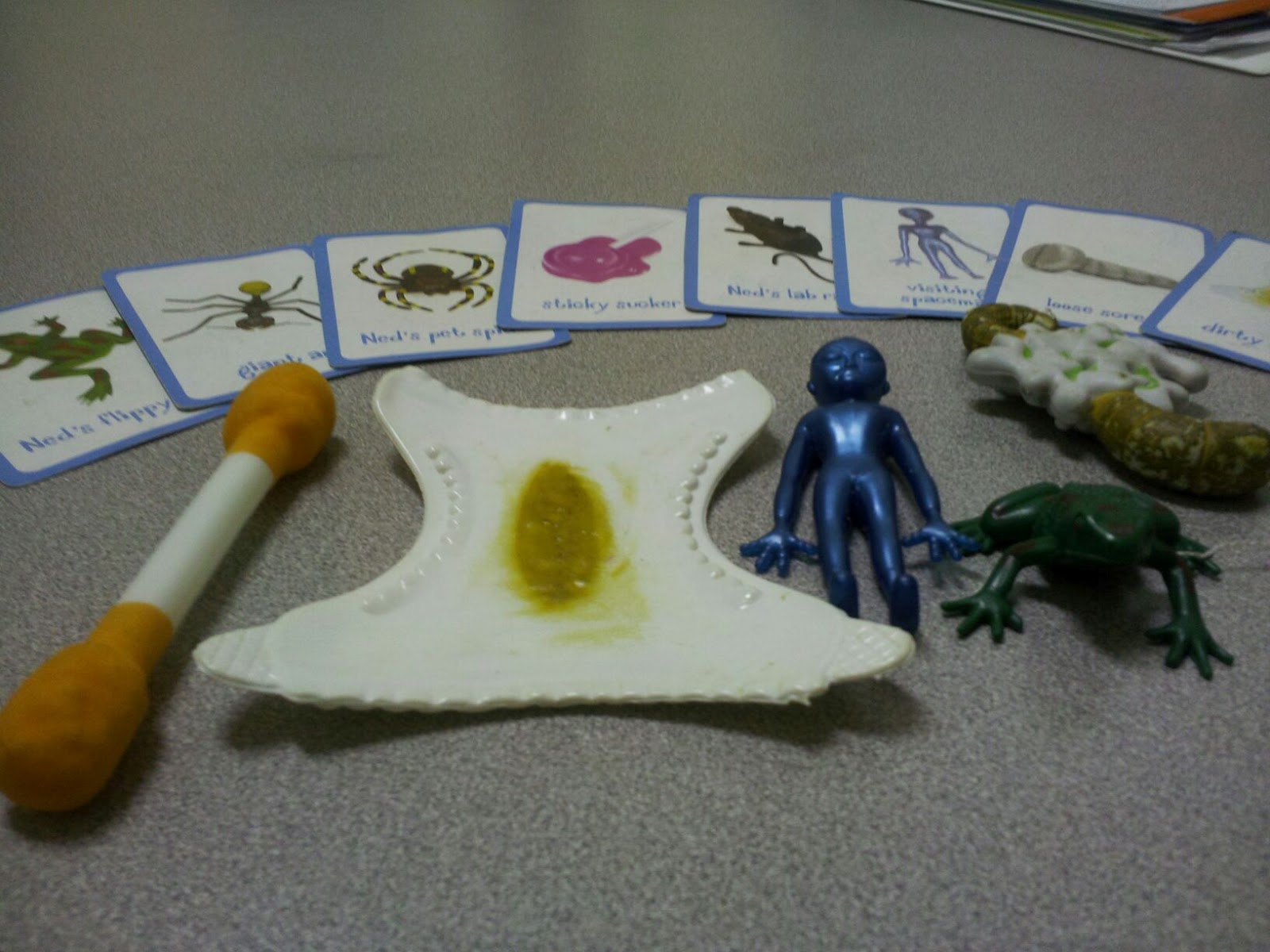
Ned's Head

Lately the greatest ally in my speech room has been good ole Ned. Does Ned come to visit your speech room too?

 I can’t even begin to describe how much my boys LOVE this game. It is amazing what a group of second grade boys will do if you promise a few minutes with Ned at the end of their session! But beware, Ned is not for the weak of stomach. He has been through a lot and you will find everything from an alien to a dirty diaper rolling around in his head! The concept is really quite simple. I allow each student to draw one card from the stack, then with their eyes closed they must feel around for the object that is pictured on their card. If they find the object they can keep it and the card, if not, the card goes back into the stack. Whoever found the most objects in the end wins!

This game is easy to incorporate into therapy. For example, have the student say a target word/phrase/sentence before they can reach into the head, or have them make up a silly phrase/sentence about the object they found using their target sound. I have also used it with my students who were working on matching pictures to objects.  If they were able, they reached into the head to pull out an object then they had to find the picture that matched what was in their hand. For language kids you can work on possessives, expanding utterances (ant… big ant, sock… dirty sock), just be creative! Something else that I love about this game is that it came with several blank cards so that you can add your own objects!

If you know Ned, how do you use him with your speech kiddos?
For other ideas about Ned, check out Kristen’s post here.


Saturday, November 5, 2011

5 More Games that Can Double as SLP Learning Tools

Today we have another guest post from our friend Philip J Reed, on behalf of Westwood College. As a follow up to his post, 5 games to use in speech therapy, Philip has provided us with 5 more game ideas! Be sure to comment and let us know what games you like to use in therapy!

A few months ago we presented an article about popular games that can double as Speech-Language Pathology learning tools.  We not only had a lot of fun writing it, but it got our minds thinking about many other games, and how easily they, too, can be integrated into your SLP program.

Patients respond best to activities that engage them, and games do that.  Games are particularly appealing to younger patients, who might not be fully aware of the value of their lessons.  By using popular games in your routines – games with which your patients are already familiar and fond of – you can keep them focused, keep their attention, and keep them excited.  So here are five more games you can utilize in your SLP program!

1)    MONOPOLY

There is perhaps no better game suited to personal interpretation than Monopoly!  How many times have you found yourself arguing with friends over the rules, even though you both “know how to play?”  It is because of this flexibility, though, that the game lends itself so well to SLP programs.  From the simplest possible uses (have your patients read the names of the properties on the cards, and then place them with the matching space on the board) to more free-form creative exercises (ask them to come up with a story for what a dog or a top hat is doing buying real estate in the first place!), Monopoly’s therapeutic possibilities are limited only by your own creativity.  The fact that its stacks of money can be used as rewards for completing various exercises and assignments, redeemable later for prizes or treats, is just icing on the cake!

2)  GUESS WHO

The structure of Guess Who makes it quite a bit more rigid than Monopoly, but it’s still a great tool.  The game consists of two racks of faces, each of which is distinct in its own way.  Two players ask questions about what the correct face looks like, until only one possibility remains and the identity is revealed.  By simply playing the game SLP patients will be learning (and using) various important descriptive words.  “Hats,” “glasses,” “mustaches” and related terms will be in use, and you can even integrate emotional terms as well, such as “happy,” “sad” and “shy.”  Try requiring patients to use at least two words to describe somebody’s features, such as “red hat,” “dark glasses” or “curly hair.”  The best thing about this game is that you can play it without needing the game at all.  By using pictures of friends, family members, or even celebrities or past presidents the game can be played just as well, and it might turn out to be even more engrossing that way!

3)  OLD MAID

If you purchase an Old Maid deck, the odds are good that you will find that the cards feature exaggerated, cartoony characters, often with humorous names or accessories.  I’m sure you can see where we’re going with this!  Rather than just using the cards to play Old Maid, you can use them as sort of conversational flash cards.  Shuffle the deck and pick out a character at random.  Have your patient describe that character to the best of his or her abilities, and then ask followup questions that require a little creativity in how they’re answered.  Try questions like, “What do you think this person does for a living?”  “What would you ask this person if you could ask any question?”  “Do you think this person would make a good friend?”  By following up each of these questions by asking why they answered the way they did, you will help them learn to communicate more effectively, and you will also help them to build conversational confidence as they do so.

4)  ANGRY BIRDS

Yes, you read that right!  According to Geek SLP, everybody’s favorite timewaster Angry Birds can be utilized in your SLP program more easily than you might think!  She recommends using the game as a springboard to writing assignments (“Do all birds work the same way?”  “Why do you like Angry Birds?”), playing the levels together and requiring the student to describe what he or she is going to do before they do it (“You could even have a list of vocabulary words you would like the student to use when describing their strategies”), and explaining the result of their actions (“You first did this…then that…”).  Of course, with a framework this loose almost any computer game would work, but this should at least get you thinking about interesting ways to use them!

5)  CHECKERS

Does this one surprise you?  After all, there are no words or pictures in checkers at all.  It’s a game with only two colors, two shapes, and a single grid.  And yet it’s a classic that has kept generations and generations intrigued by its simple but strategic fun.  So how can you use it in your SLP program?  Well, the rules of the game are clearly enough known, so play a game with your patient and pause periodically to ask him or her about different moves.  Point to a piece and have your patient explain the moves it could make, and also which of those moves would be bad, which would be good, and why.  Discuss strategy with them, and also cause and effect.  A good move now may turn into a bad move later, so explain why that happens.  You can even make deliberately poor moves and allow your pieces to be taken, requiring them to explain why that was a bad move and how they will capture your piece before they do so.

Just as before, these constitute only a small sampling of popular games you can use in your SLP program.  When it comes to your patients, your formal training and a medical assistant degree will help you a great deal.  But also very helpful is a good deal of resourcefulness and creativity!

Saturday, October 8, 2011

We All Scream For Ice Cream

Everybody loves ice cream, even if it is in the form of foam! My SLP friend Aftyn has this great ice cream game, but I wasn’t sure where she got it from so I decided to make my own! Keep reading to learn how to make a FUN AND EASY ice cream game to play with your kiddos!

Step 1: Print out this template and cut out all the ice cream parts.

Step 2: Then trace the cones and scoops on to foam paper. (Foam paper can be purchased at any craft store. I would suggest getting colors that look like ice cream flavors such as white for vanilla, brown for chocolate, etc.)


Step 3: Cut out your cones and scoops! We drew some lines on the cones to make them look a little better.  Also, you need to make more half scoops than cones or full scoops because this is what you will use the most in the game.


The full scoops will go on the cone first and the half scoops fit over them so you can keep stacking up your ice cream! And that’s all there is! Cut out as many scoops as you want on different colors! How easy was that?!
How to play: Each player gets one cone. After they say their word (or whatever task you wish) they get to roll the dice and that is how many scoops they can add to their cone. The person with the most scoops at the end wins! We usually use a dice that only has 1, 2, or 3 on each side. You will needs LOTS of scoops if you use a regular dice. This game is great because it is generic, you can use it for any phoneme or language activity. I love to use this to talk about flavors. I am always amazed at how the concept of flavors alludes so many of my kids!


Thursday, June 16, 2011

Top 5 Toys

Below are the top 5 toys our kiddos LOVE! If you want to add some new toys to your shelves consider these! Our students always work hard for a chance to play with these toys. Remember, we mostly see preschool and elementary age children so the following may not be appropriate for all ages. Even if you are not a “speechie” but just looking for fun toys for the kids, these are great! (We are not getting money for endorsing the toys. We just really like them!) Leave a comment and tell us what toys your students/kids love!
      
Image from kaboodle.com


5. Lucky DucksKids absolutely LOVE this game! But beware. It makes noise. A lot-o-ducks-quacking noise. Our best advice is to buy the new edition that is quieter than the original. It may cost a little more, but trust me your sanity is more valuable. Kids pick a duck out of the pond to see if the color/shape matches their card.

Image from kaboodle.com

4. Fisher Price Piggy BankAnother kiddo fave. The pig counts as you drop the coins in and sings different songs. But don’t worry; you have the option of turning the sound off if your nerves can’t handle it that day (at least until your student figures out how to work the button and then you’re dunzo). It is spectacular for ABA therapy. It is an instant reward that is quick so you can get back to work. We happen to come across this pig at a thrift store for $1.25. Best. Purchase. Ever.

Image from piratesuperstore.com

3. Pop Up PirateThis is a great game for both preschoolers and older kids (We have 5th graders that love this). Warning: The pirate really does “pop up” (shocking we know!) so don’t let it startle you! (One of the Speech Ladies may or may not have jumped in her chair on occasion when the pirate “popped”.)

Image from Harrisburg.craiglist.org

2. Playskool MailboxThere is so much you can do with this! Mail away artic cards, tokens, or letters.  And the kids love to open the mailbox to pull it all out! This is the old school version so we’re sure the new version is even better! There are holes for the kids to drop in the blocks, but we lost those long, long ago.

Image from superduperinc.com

1.     Chipper Chat – This is another fantastic toy for ABA therapy. There are different cards to choose from and when your student fills theirs up or has completed the number of trials you set, then they can use the magic wand to pick up all the chips! The kids are amazed by the wand every time. Seriously. They will turn it over and over trying to figure out how it works. Too cute!